



I am Farina, recently appointed Head of Sales at Panintelligence, and like many sales leaders I have spent far too much of my career acting as a pseudo data architect, analyst and occasional data scientist simply to get answers I could trust. That reality is far more common than we admit in sales leadership circles, and it usually starts with good intent.
The Problem with Traditional Sales Dashboards and CRM Reporting
In previous roles, I worked closely with data teams to define dashboards, waited weeks for them to be built, admired how polished they looked, then immediately exported them to Excel to make them usable, really. The dashboards looked impressive but said very little. They were full of vanity metrics that felt reassuring but did nothing to improve pipeline quality, forecast accuracy or conversion. Activity was visible, impact was not.
Confidence in the numbers was low because definitions shifted, systems did not talk to each other, and context was missing. Sales teams quietly created their own reports just to feel safe. Leaders spent meetings debating whose numbers were right rather than what action to take. Huge amounts of time were lost manipulating data, reconciling spreadsheets and rebuilding reports, time that should have been spent selling, coaching and progressing deals. The cost was not just inefficiency, it was slower deal velocity, reactive forecasting, inconsistent coaching and unnecessary revenue risk.
When Sales Leaders Cannot Trust Their Revenue Data
The most frustrating part was not the lack of data, it was the inability to answer basic commercial questions with confidence. Where is the funnel really leaking. Which inbound leads actually convert. Which outbound motions drive progression rather than noise. Where do deals stall and why. Which losses are genuinely competitive and which are self inflicted. Without trusted, joined up insight, leadership decisions were often based on instinct rather than evidence.
Drinking Our Own Champagne: Using Our Business Intelligence Platform Internally
When I joined Panintelligence, I was given a very simple challenge, drink our own champagne. That meant using our own platform internally to solve the exact problem I had lived with for years. The objective was not to build prettier dashboards, it was to establish a single version of the truth across Salesforce and Outreach, and to make that insight available on demand, without manual report creation or offline manipulation.
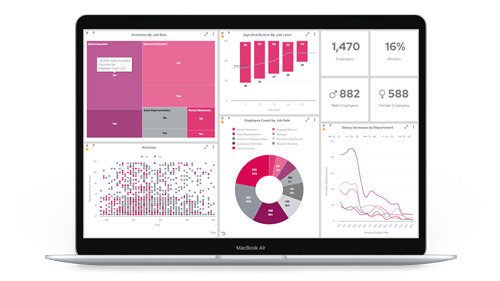
What changed was not just tooling, it was intent. We started with the full revenue journey, from marketing funnel through to closed outcomes. We built integrated dashboards that show inbound and outbound leads side by side, with clear conversion ratios at each stage. We can see funnel efficiency, where volume looks healthy but quality does not, and where activity is high but progression is weak. Marketing, sales development and sales leadership are looking at the same data, with the same definitions, in real time.
Improving Pipeline Visibility, Deal Velocity and Forecast Accuracy
From there, the focus moves into sales pipeline health. We can see stage conversion ratios, deal velocity, ageing, and slippage without pulling reports or exporting data. Pipeline reviews are no longer about defending numbers, they are about understanding blockers and agreeing action. Forecast conversations are shorter, sharper and far more confident because the underlying data is trusted.
Crucially, we also track outcomes properly. Win and loss reasons are not buried in notes or summarised once a quarter. They are visible, structured and connected back to source, segment and motion. We can see which wins are driven by value alignment, which losses are driven by competition, pricing or timing, and where we need to change our approach. This insight is not owned by me alone. It is used by marketing to refine messaging, by sales leaders to coach effectively, and by the wider business to align product and go to market decisions.
How Sales Analytics Changes Behaviour
The biggest shift has been behavioural. Reps spend less time reporting and more time selling. Leaders spend less time reconciling data and more time supporting their teams. Conversations are grounded in evidence rather than opinion. Analytics has moved from being a retrospective reporting function to an active sales enablement capability.
For other sales leaders, there are some familiar warning signs worth reflecting on. If your dashboards look good but do not change behaviour. If pipeline meetings focus on whose numbers are right. If Excel is still the safety net. If reporting takes more time than selling. These are not tooling problems, they are operating model problems.
The Lesson for Modern Sales Organisations
For me, the lesson has been clear. Internal analytics only works when it is trusted, integrated and built around how sales teams actually operate. When that happens, insight stops describing activity and starts enabling performance. That is what we have achieved internally at Panintelligence, and it is the standard I now expect for any modern sales organisation.
If you are reading this as a standalone piece, it sits within a broader internal story. Across sales, product, finance and leadership, we have deliberately documented how different roles experience the same underlying challenge from very different angles, and how a shared internal analytics approach changes outcomes. From sales moving beyond exported dashboards and vanity metrics, to product teams connecting customer signal, roadmap intent and delivery quality, to finance reducing manual risk and supporting renewals through a true Customer 360 view, each perspective reflects a real internal use case rather than a theoretical one.
Taken together, these stories explain what we mean by drink your own champagne at Panintelligence. We run the business on the same platform we advocate externally, with role specific insight built on shared definitions and trusted data. The result is not more reporting, it is better ways of working, clearer decisions and less operational noise. Even when viewed in isolation, each blog tells part of that story. Collectively, they show how internal analytics becomes the foundation for a calmer, more deliberate and more scalable organisation.