



There is a moment most CEOs, COOs and operational leaders recognise instantly, five reports, ten opinions and zero clarity. The numbers are not obviously wrong, but no one is completely confident either, and the room goes quiet in that very specific way that signals shared discomfort rather than disagreement. If you have ever found yourself silently recalculating the story in your head while a meeting moves on, this will feel familiar.
Why Leadership Teams Struggle With Fragmented Data
Modern organisations run on an expanding stack of systems, each excellent in isolation, each telling part of the story, and collectively creating friction at the leadership level. We rely on Salesforce for revenue and pipeline, Xero for finance, Zendesk for service health, Outreach for sales activity, and Git and Jira for delivery and engineering. Each system works well on its own, but leadership questions have an inconvenient habit of cutting straight across all of them.
At an executive level, the questions rarely sit neatly inside a single tool. How sales performance connects to delivery capacity. Whether support trends are starting to threaten renewals. If cash position genuinely aligns with pipeline reality. Whether operational execution is keeping pace with ambition. Too often, answering those questions means acting as the human reconciliation layer between multiple systems and a spreadsheet. The outcome is predictable, five reports, ten opinions and still no clarity on what decision to take or which trade off actually matters.
Scaling Operations Without Losing Clarity
This tension compounds as businesses scale. What feels just about manageable at twenty or thirty people becomes operational drag at one hundred and material risk beyond that. More customers, more products, more teams and more systems all increase complexity, but leadership expectation does not scale in the same way. Boards still expect clarity. Investors still expect confidence. Teams still expect direction. Without a single version of the truth, growth introduces noise rather than momentum.
This is where operational maturity really shows. Scaling well is not about adding more dashboards or hiring more people to explain the numbers. It is about creating coherence as complexity increases. When leaders cannot fully trust the data, decisions slow, accountability fragments and chaos quietly creeps in, often disguised as the unavoidable cost of growth. Left unresolved, this becomes a leadership tax, time spent arbitrating numbers instead of setting direction, aligning teams and executing strategy.
Why Board Reporting Exposes Data Fragmentation
Board reporting intensifies this pressure further. Timelines are tighter, scrutiny is higher and tolerance for ambiguity is low. Many leadership teams still rely on manually curated board packs that are weeks out of date by the time they are reviewed, disconnected from live operational reality and difficult to interrogate when questions inevitably arise. Standing behind a board pack while knowing how much stitching together happened behind the scenes is an uncomfortable position for any executive.
How Panintelligence Creates a Single View of the Business
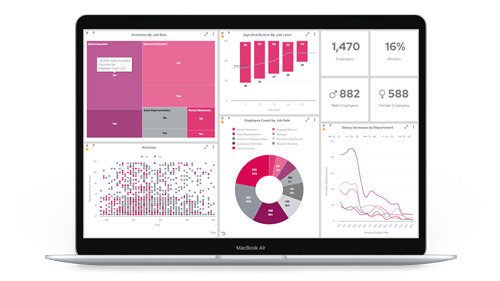
This is exactly the internal problem we focus on at Panintelligence. Internally, we use Panintelligence to sit across our operational systems and present a single, trusted view of the business, live, governed and consistent. Revenue, finance, delivery, support and operations are connected through shared definitions rather than spreadsheets, late nights and heroic effort.
Drinking Our Own Champagne: Running the Business on Analytics
More importantly, this is not optional. Every member of the Panintelligence team has a clear drink your own champagne objective. We expect the business to be run on the same insight we advocate externally. That expectation creates discipline, consistency and accountability, and it removes the gap between what we say and how we operate.
This insight is not owned by one role or one team. Leadership, functional heads and operational managers all work from the same source of truth, whether reviewing performance, planning capacity or preparing for board discussion. Board reports are not a separate exercise. They are formatted, governed outputs generated directly from the same trusted data, which becomes increasingly critical as organisations grow and scrutiny increases.
The impact is behavioural rather than cosmetic. Fewer debates about whose numbers are right. Faster, more confident decisions. Clearer ownership. Less operational noise. Scaling feels controlled rather than chaotic because leaders are no longer compensating for gaps in information.
Why Data Coherence Is a Leadership Decision
For CEOs, COOs and operational leaders, the challenge is rarely a lack of data. It is the absence of coherence. Choosing a single version of the truth is not a technology decision, it is a leadership decision. When organisations live with five reports, ten opinions and zero clarity, leadership becomes reactive by default. When coherence is established, it becomes a marker of operational maturity and an essential foundation for scaling effectively.
If you are reading this as a standalone piece, it sits within a broader internal story. Across sales, product, finance and leadership, we have deliberately documented how different roles experience the same underlying challenge from very different angles, and how a shared internal analytics approach changes outcomes. From sales moving beyond exported dashboards and vanity metrics, to product teams connecting customer signal, roadmap intent and delivery quality, to finance reducing manual risk and supporting renewals through a true Customer 360 view, each perspective reflects a real internal use case rather than a theoretical one.
Taken together, these stories explain what we mean by drink your own champagne at Panintelligence. We run the business on the same platform we advocate externally, with role specific insight built on shared definitions and trusted data. The result is not more reporting, it is better ways of working, clearer decisions and less operational noise. Even when viewed in isolation, each blog tells part of that story. Collectively, they show how internal analytics becomes the foundation for a calmer, more deliberate and more scalable organisation.