



Being a Head of Product usually means being asked to commit to decisions with confidence while quietly knowing the information underneath is fragmented. Are we building the right thing. Are we building it at the right time. Are we building it well. The uncomfortable truth, in many organisations I have worked in, is that the answer depends on which system you open first and who you spoke to most recently. If you have ever been asked to lock a roadmap or release date while mentally caveating half the assumptions, you will recognise the feeling.
When Product Leaders Become the Integration Layer
I am Kieran, Head of Product at Panintelligence, and before joining Panintelligence I lived the reality many product and development leaders quietly accept. Customer insight lived in Zendesk, delivery lived in Jira, quality lived somewhere else entirely, often summarised manually from tools like Qase, and cloud health sat in yet another set of dashboards. Insight was everywhere, but coherence was not.
Understanding customer needs meant reading a lot of tickets, interpreting feedback and trying to separate genuine product signals from background noise. Roadmap discussions were thoughtful, but often influenced by recency bias, escalations or whichever issue had caused the most pain that week. More than once, I found myself defending a priority decision not because the data was clear, but because I had stitched together enough context to make it sound convincing. Product leadership quietly became the integration layer between tools.
Delivery added another layer of complexity. Engineering teams focused on throughput. Quality was assessed after the fact. Cloud teams monitored stability, often without full visibility of what was changing and why. Status meetings followed a familiar ritual, slides assembled late the night before, optimistic green indicators, and a shared hope that nothing unexpected would surface before the next release.
Drinking Our Own Champagne at Panintelligence
When I joined Panintelligence, I was given the same mandate as the rest of the leadership team, drink your own champagne. If we believe embedded analytics reduces friction and improves decision making, then our own product, development and delivery teams should be running on it too.
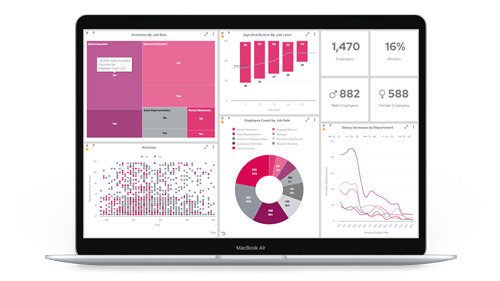
The first dashboards we built focused on customer signal. Zendesk data is no longer a wall of tickets. It is surfaced as structured insight showing recurring issues, emerging themes, volume trends and severity. Instead of debating what customers are complaining about, we can see it, quantify it and track how it changes over time as we ship improvements. One immediate impact was shorter prioritisation discussions because the evidence was visible to everyone in the room.
The next layer connects customer insight directly to roadmap intent. We track roadmap themes and epics alongside customer pain points, which makes trade offs far clearer. It becomes obvious which work addresses genuine customer friction and which items are simply noise. This has materially reduced reactive reprioritisation and the cycle of revisiting the same debates sprint after sprint.
Bringing Delivery Visibility into Focus
Delivery dashboards then bring execution into focus. Jira data shows progress, throughput, ageing work and bottlenecks in context. I can see where delivery is flowing well and where it is not without relying on reassurance or anecdotal updates. Conversations with engineering have shifted from how are things going to where do we need to intervene, and those interventions happen earlier.
Quality dashboards built on Qase data complete the picture. Test coverage, defect trends and release quality sit alongside delivery metrics as live signals. Quality is no longer something we review once a release is out of the door. It informs readiness and risk before decisions are locked in. The result has been noticeably fewer release surprises and far fewer last minute trade offs driven by uncertainty.
Creating a Shared Source of Truth Across Teams
Crucially, these dashboards are not just for me. Product managers, engineers, testers and cloud teams all work from the same source of truth. Customer insight, roadmap intent, delivery progress and quality signals are visible to everyone who needs them. That shared visibility removes friction. Less explaining. Fewer assumptions. Faster alignment.
One of the less obvious but most powerful impacts has been how this has changed the way we work and improve over time. When insight is fragmented, retrospectives tend to drift into opinion, recency bias and selective memory. We talk about what felt painful, what was loudest, or what happened most recently, rather than what actually mattered over the sprint or release.
With shared, trusted dashboards, retrospectives become grounded very quickly. We can look at customer signal, delivery flow, quality trends and release outcomes together and ask better questions. Where did friction really occur. What patterns are repeating. Which changes genuinely improved outcomes and which simply moved the pain elsewhere. The conversation shifts from who thinks what went wrong to what the data is telling us.
That shift has been a catalyst for continual improvement. Small issues surface earlier. Process changes are tested and evaluated rather than debated. Teams can see whether an adjustment improved flow, quality or customer impact in the next cycle. Improvement stops being an abstract ambition and becomes part of how we work week to week.
Importantly, this is not about measuring teams harder. It is about giving them clearer feedback loops. Engineers, product managers and testers can see the impact of their decisions over time. That creates learning rather than defensiveness. Retros feel constructive rather than performative, and improvement feels intentional rather than reactive.
From Reactive to Proactive Product Leadership
The biggest shift overall has been behavioural. We are more proactive. Patterns in customer pain are spotted earlier. Delivery risk is identified sooner. Quality issues are addressed before they become incidents. Product leaders spend less time preparing evidence and more time shaping direction. Engineers spend less time defending progress and more time delivering value. Meetings move from storytelling to decision making.
The impact shows up in practical ways. Fewer emergency reprioritisations. Shorter and calmer prioritisation cycles. Improved delivery predictability. Reduced rework and fewer production issues that disrupt cloud and support teams. Even small improvements in these areas compound quickly as teams scale.
For product and development leaders, the warning signs are easy to recognise. Customer feedback trapped in support tools. Roadmaps driven more by instinct than insight. Quality surfaced too late to influence outcomes. Status meetings that feel like performance theatre rather than genuine decision forums. These are not tooling problems. They are coherence problems.
Drinking our own champagne at Panintelligence has reinforced something I now see as non negotiable. Internal analytics for product and engineering only works when customer insight, roadmap intent, delivery execution and quality signals are connected. When they are, blind spots disappear, teams learn faster, and building software feels far less chaotic and far more deliberate.
If you are still acting as the human integration layer between half a dozen tools, the question is not whether you have enough data. It is whether you have the feedback loops needed to improve continuously and whether you can continue to scale without chaos.
Part of a Broader Internal Analytics Story
If you are reading this as a standalone piece, it sits within a broader internal story. Across sales, product, finance and leadership, we have deliberately documented how different roles experience the same underlying challenge from very different angles, and how a shared internal analytics approach changes outcomes. From sales moving beyond exported dashboards and vanity metrics, to product teams connecting customer signal, roadmap intent and delivery quality, to finance reducing manual risk and supporting renewals through a true Customer 360 view, each perspective reflects a real internal use case rather than a theoretical one.
Taken together, these stories explain what we mean by drink your own champagne at Panintelligence. We run the business on the same platform we advocate externally, with role specific insight built on shared definitions and trusted data. The result is not more reporting, it is better ways of working, clearer decisions and less operational noise. Even when viewed in isolation, each blog tells part of that story. Collectively, they show how internal analytics becomes the foundation for a calmer, more deliberate and more scalable organisation.