



If you ever want to see a finance leader flinch, ask a question that sounds simple on the surface. What is our real renewal risk this quarter. Which customers should we be worried about right now. Are we genuinely confident in this number. The answer almost never lives in one place, and it is rarely as clean as the spreadsheet implies. That flinch is not uncertainty, it is experience recognising risk.
I am Catherine, Head of Finance at Panintelligence, and like most finance leaders I have spent a large part of my career being asked to provide clarity, confidence and control while quietly stitching together data from multiple systems to make the story hold. Revenue in one place. Customer context in another. Renewals somewhere in between. And Excel sitting in the middle, trusted, familiar, and doing far more heavy lifting than it ever should.
Why Excel Becomes the Backbone of Finance Reporting
Finance teams have a complicated relationship with Excel. We love it, and for good reason. It is flexible, fast and incredibly powerful for modelling, scenario planning and one off analysis. Excel absolutely has a time and a place. The risk creeps in when it quietly becomes the backbone of core reporting, renewal tracking and operational decision making. At that point it stops being an analytical tool and starts acting as infrastructure, without the governance, auditability or resilience that infrastructure requires.
The Hidden Risk of Fragmented Finance Data
In most organisations, core financial data lives in systems like Xero, while customer, contract and renewal context sits in tools such as Salesforce. Individually, these systems work well. Collectively, they leave gaps. Reconciling invoicing, contract values, renewal dates, payment status, pipeline activity and customer health becomes a manual exercise. Copy and paste. Version after version of the same file. Logic that only one person fully understands. The manual overhead is significant, and the risk often remains invisible until it matters.
Renewals amplify this pain. Finance is frequently pulled into renewal conversations late, expected to validate figures and confirm commercials under time pressure. Without a joined up view, renewal risk is assessed reactively. Are invoices being paid on time. Has usage dipped. Are support tickets increasing. Are there unresolved issues that could impact confidence. The data exists, but it is scattered, so finance becomes the final checkpoint rather than an early warning system.
Alongside this sits another responsibility that often goes unspoken. Finance plays a key role in collating and tracking business and team level OKRs. That means understanding whether objectives are being met, where performance is drifting, and how operational reality maps back to financial outcomes. When insight is fragmented, OKR tracking quickly turns into spreadsheet management. Updates lag reality. Variance explanations dominate conversations. Finance reports on performance instead of helping the business improve it.
Drinking Our Own Champagne: Using Analytics Internally
When we talk about drinking our own champagne at Panintelligence, this applies just as much to finance as it does to any other function. Internally, the expectation is clear. We do not rely on Excel as the glue holding the business together. We use Panintelligence to bring financial, commercial and operational insight into a single, trusted view that reduces manual effort and removes unnecessary risk.
The Value of a Customer 360 Dashboard for Finance
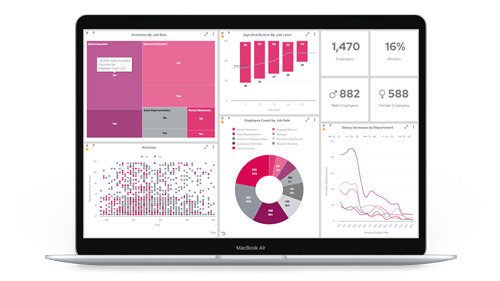
One of the most valuable outcomes for me has been our Customer 360 dashboard. This brings together financial data from Xero with customer and commercial context from Salesforce. I can see customer revenue, contract terms, renewal dates, invoicing status, pipeline activity, engagement signals and support trends in one place. Instead of exporting data into spreadsheets to assess risk, I can see it live, in context, and early.
This has fundamentally changed how finance supports the renewals process. We are no longer validating numbers at the end of the cycle or rebuilding models under pressure. We are contributing insight earlier. Which renewals need attention. Where risk is increasing. Where strong engagement suggests opportunity rather than concern. Finance moves from reactive to proactive, which is exactly where it should be, particularly as the business scales.
The same shift applies to OKRs. Business and team level objectives are now supported by live insight rather than static reports. Finance can see how sales, delivery and customer health are tracking against targets and flag issues earlier. Conversations move away from explaining variances and towards addressing them.
Shared Insight Across Sales, Customer Success and Finance
Crucially, this insight is not locked inside the finance function. Sales, customer success and leadership teams all work from the same Customer 360 view. That shared visibility removes friction. Fewer last minute questions. Fewer reconciliations. Fewer uncomfortable surprises just before a board meeting.
The impact is tangible. Less manual overhead. Reduced operational risk. Earlier visibility of renewal issues. More confident forecasting. Finance spends less time managing spreadsheets and more time helping the business make better decisions. Excel returns to what it does best, modelling and analysis, rather than acting as a fragile system of record.
Why Finance Leaders Need a Single Source of Truth
For finance leaders, the warning signs are easy to recognise. Critical models owned by individuals rather than the business. Renewal risk discovered too late. OKRs tracked offline. Hours spent validating data instead of advising the organisation. These are not Excel problems. They are coherence problems.
For finance leaders, coherence is not a reporting preference, it is a control mechanism. When insight is fragmented, risk hides in the gaps between systems and spreadsheets. When a single, trusted view exists, finance can do what it is meant to do, protect the business, enable growth and guide decisions with confidence. Drinking our own champagne at Panintelligence has reinforced that finance delivers its greatest value not when it reconciles the past, but when it helps the organisation see what is coming next.
How Internal Analytics Connects Sales, Product and Finance
If you are reading this as a standalone piece, it sits within a broader internal story. Across sales, product, finance and leadership, we have deliberately documented how different roles experience the same underlying challenge from very different angles, and how a shared internal analytics approach changes outcomes. From sales moving beyond exported dashboards and vanity metrics, to product teams connecting customer signal, roadmap intent and delivery quality, to finance reducing manual risk and supporting renewals through a true Customer 360 view, each perspective reflects a real internal use case rather than a theoretical one.
Taken together, these stories explain what we mean by drink your own champagne at Panintelligence. We run the business on the same platform we advocate externally, with role specific insight built on shared definitions and trusted data. The result is not more reporting, it is better ways of working, clearer decisions and less operational noise. Even when viewed in isolation, each blog tells part of that story. Collectively, they show how internal analytics becomes the foundation for a calmer, more deliberate and more scalable organisation.