



Software as a service (SaaS) organizations have always been at the forefront of innovation. It's the nature of the business. But Artificial Intelligence (AI) has been the catalyst for enormous change. Together, AI and SaaS are reshaping business operations, redefining customer experiences, and driving innovation across industries.
Let's take a closer look at what makes AI SaaS so impactful and why so many SaaS organizations have opened their arms to AI.
What is AI SaaS?
SaaS solutions transcend industries and functions, offering tools from payment processing to data storage. AI SaaS further elevates this model by providing scalable, cloud-based AI technologies - such as Machine Learning (ML), Natural Language Processing (NLP), and Causal AI - without requiring heavy investments in infrastructure or specialized talent.
By removing the complexity of in-house AI development, AI SaaS enables businesses to quickly adopt innovative strategies, tackle challenges, and boost efficiency. Its subscription-based model ensures flexibility and scalability, allowing organizations to easily adapt to evolving demands and access cutting-edge AI capabilities. Whether enhancing operations or driving innovation, AI SaaS empowers businesses of all sizes to compete on an even playing field.
Top 5 benefits of AI in SaaS applications
AI is transforming organizations' operations, improving efficiency, security, and personalization. Let's explore how AI is enhancing SaaS applications:
1. Predictive analytics
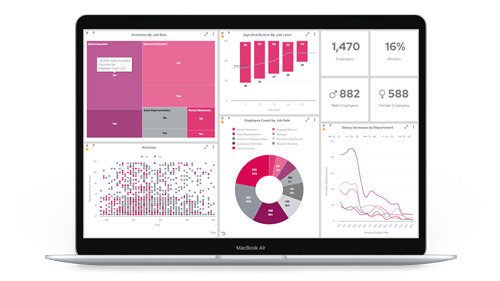
AI can sift through large amounts of data to identify patterns and predict future trends; this can be done through Causal AI, which is a form of AI designed to find the root cause of issues to help with human interventions. An example of Causal AI use is, in a SaaS HR application, understanding employee attrition, understanding the most 'at risk' category of employees and their reasons in common to find the root cause of the issue to help aid conversations with this group of employees.
2. Personalization
AI makes it easier to understand user preferences by analyzing their data, which allows for tailored recommendations. A good use case example is with SaaS marketing automation, where personalized messages can boost conversion rates significantly.
3. Automation
Repetitive tasks like data entry and report generation can be handed over to AI, freeing employees to tackle more strategic work. For example, automation can simplify workflows and save valuable time in SaaS project management tools.
4. Customer service
AI is transforming customer service by reducing the volume of support tickets and pinpointing potential friction points. This lets support teams focus on more complex issues while improving the overall customer experience.
5. Cost savings
By streamlining workflows and reducing manual work, AI lowers costs and boosts efficiency. The benefits of reducing manual workload are particularly visible in smaller businesses that lack the resources to maintain large teams to manage their SaaS operations.
Examples of SaaS companies leveraging AI
Let's explore some innovative examples of how AI is seamlessly integrated into leading SaaS platforms:
- ServiceNow integrates AI to enhance IT operations by automating incident resolution, predicting system outages, and streamlining workflows through AI-driven virtual agents.
- Asana uses AI to assist in project management by prioritizing tasks, predicting deadlines, and offering insights to optimize team collaboration and efficiency.
- Shopify leverages AI to boost e-commerce operations, offering merchants AI-powered insights for inventory management, personalized product recommendations, and enhanced customer service tools.
- Workday applies AI to human resources and financial management, utilizing predictive analytics for talent acquisition, workforce planning, and financial forecasting.
- ZoomInfo uses AI to empower sales and marketing teams with accurate, real-time data enrichment, lead scoring, and advanced prospecting capabilities.
These examples just scratch the surface of how SaaS platforms amplify their value propositions by incorporating AI. Naturally, like any other technology, AI will continue to evolve, and we can expect to see even more groundbreaking innovations at the intersection of AI and SaaS.
Navigating the challenge of ethical AI for SaaS
While AI in SaaS opens exciting doors, it has challenges. For AI to succeed in SaaS, trust and its ethical use is essential. When navigating AI SaaS, consider the following:
- Bias: AI systems can inadvertently reflect and perpetuate biases, leading to unfair or discriminatory outcomes. An example of this is in a financial SaaS application. Services like loan approvals and biased algorithms can disproportionately disadvantage marginalized groups, creating significant ethical concerns.
- Accountability and transparency: SaaS organizations, especially high-stakes ones, such as AI-driven compliance tools, must have clear and traceable responsibility. When errors do occur, accountability becomes challenging, emphasizing the need for greater interpretability and regulatory oversight.
- Privacy: Training AI models often require large datasets, which raises concerns about data privacy and security. This issue is particularly critical in SaaS applications like healthcare platforms, where sensitive patient information must remain confidential.
Addressing these challenges is essential for the responsible deployment of AI in SaaS, ensuring that these technologies deliver benefits without compromising ethics, privacy, or accountability.
Looking ahead: AI's role in the future of SaaS
Grand View Research has predicted that AI in SaaS will reach $1.8 trillion by 2030, growing at a CAGR of 36.6% from 2023 to 2030. So, AI SaaS is going nowhere - its future is brimming with possibilities. However, from our point of view, we think the following will happen to AI SaaS in the near future.
SaaS businesses will take a step back and evaluate
The launch of ChatGPT caused a huge stir not just in SaaS but universally for organizations and individuals. After this ChatGPT boom, adoption was at an all-time high. SaaS organizations were very keen to integrate AI capabilities into their applications, and this blog has outlined how this can and has been done very successfully. However, the pressure of the C-suite to appease board members and investors and quickly adopt this new technology won't benefit all.
In the future, we expect to see some organizations taking a step back, evaluating what they have implemented and taking a hard look at what they have achieved. We have found that some were quick to react to the AI hype, but did speed superseded the need. How will these organizations adapt, improve and maybe even backtrack? Only time will tell.
Keeping the human in the loop
Do we want to put everything into the hands of the AI? That depends on the circumstances and nature of the organization. However, in our opinion, there will be more of a need to keep the 'human in the loop'. What does that mean? Well, it's taking humans along the journey with AI. So, the AI might come to a conclusion, but this opens up conversations for causality with the human to either fill in the context or dig deeper into the decision. Further understanding can come from having human conversations to justify or confirm the reasoning.
There is still an air of wariness with AI, and as more and more organizations adopt AI quickly, stringent data measures may not be in place, which might lead to errors. The errors may then perpetuate the need to bring humans along to oversee and aid.
In summary
AI SaaS is more than just a trend - it's transforming the tech industry. By understanding its benefits, tackling its challenges, and seizing its opportunities, businesses can position themselves as leaders in innovation. As AI continues to evolve, its impact on SaaS will only grow, offering endless possibilities for those ready to embrace the future.