



Contents:
In early 2025, several major UK businesses made headlines as they announced restructuring plans in response to economic headwinds and evolving customer behaviours. Among them, John Lewis and ASOS shared their intent to reshape their organisations — not as reactionary measures, but as part of longer-term strategies focused on operational efficiency, digital acceleration, and sustainable growth.
John Lewis signalled a potential reduction of 11,000 roles over five years, representing around 10% of its workforce, aligned with its renewed focus on profitability and technology-led transformation (source: BBC News) ASOS, facing continued margin pressure in a competitive e-commerce landscape, announced over 200 redundancies as part of its organisational simplification plan (source: World Footwear.).
These announcements reflect a wider shift across industries: from growth-at-all-costs to deliberate, insight-led efficiency. Businesses are no longer just scaling up — they’re recalibrating. And as teams become leaner, the ability to see clearly, act decisively, and measure meaningfully becomes essential.
Reassessing Scale in a Complex World
For years, many organisations responded to complexity by scaling headcount. New market? Add a team. New initiative? Hire a lead. New data stream? Bring in another analyst.
While this approach offered agility during periods of growth, it also introduced operational sprawl — layers of process, disconnected reporting, and increasing reliance on manual workarounds. As economic conditions tighten and technology reshapes productivity norms, the model is under scrutiny.
Today, many leaders are asking a different question:
What do we truly need to see — and who needs to see it — to run this business well?
This isn’t just about cost. It’s about clarity.
Why Visibility Is Now a Strategic Risk Factor
When reporting lacks consistency, governance, or real-time access, the business becomes reactive. And across sectors, this shows up in familiar ways:
- Finance teams spending too long consolidating data, and not enough time interrogating it
- Marketing teams allocating budget without a clear attribution path
- Customer success teams unable to spot early churn signals
- Operations leads making judgement calls without confidence in the inputs
In these moments, reporting is not just an operational concern — it becomes a strategic risk.
From Reporting Cycles to Embedded Insight
In 2025, resilience doesn’t come from weekly reports alone. It comes from contextual, embedded insight — available to the right people at the right time, without friction.
This means:
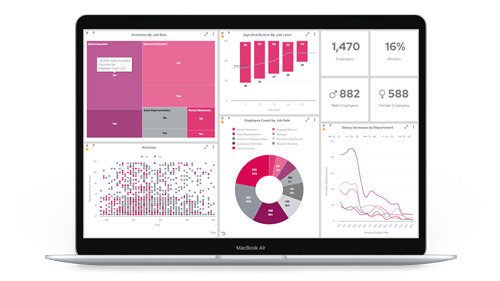
- Dashboards built around user roles, not just functions
- Data aligned across departments with a common source of truth
- Fewer meetings spent “aligning on the numbers,” and more time acting on them
The most forward-thinking organisations aren’t building more dashboards — they’re building better ones. Embedded into workflows. Designed for action. Governed for trust.
Doing More with Less: A Reality, Not a Slogan
“Doing more with less” is often used as a rallying cry. But in today’s environment, it’s more than a motivational phrase — it’s a structural reality.
Whether you're running a manufacturing firm, a university, a software company or a national retailer, the challenge is the same: improve responsiveness, reduce waste, and remain customer-focused — all while maintaining cost discipline.
Smarter reporting can’t solve every structural challenge. But it can:
- Remove ambiguity in decision-making
- Reduce time spent chasing numbers
- Empower teams to focus on the decisions that matter
Clarity becomes a differentiator. And increasingly, a necessity.
Sources:
- BBC News – John Lewis to cut thousands of jobs in bid to break even
- World Footwear – ASOS to cut 200 head office jobs