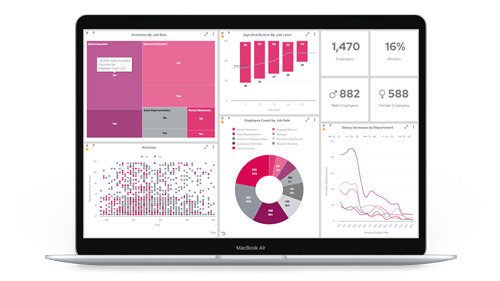




Traditional Business Intelligence (BI) has long been the standard for businesses looking to analyze data, generate reports, and guide decision-making.
However, it comes with limitations; BI tools often require specialized knowledge, take time to generate insights, and are constrained by predefined dashboards and reports.
Generative Business Intelligence (GenBI) changes everything.
By integrating Artificial Intelligence (AI) and natural language processing (NLP), GenBI allows users to interact with data in a conversational way. Instead of waiting for analysts to generate reports, anyone, regardless of technical skill, can ask direct questions and receive instant insights. This shift removes traditional barriers, making data-driven decision-making faster, more intuitive, and more accessible to all users.
What is Generative Business Intelligence (GenBI)?
Generative Business Intelligence is the next evolution of traditional Business Intelligence. It leverages AI-powered automation to revolutionize how businesses access and interpret data. Instead of relying on rigid dashboards, GenBI uses large language models (LLMs) to allow users to explore data dynamically and flexibly.
How GenBI works
Instead of manually creating reports, users simply ask questions like:
- “Which region had the highest sales growth last quarter?”
- “How did our marketing efforts impact customer acquisition?”
GenBI instantly analyzes data, generates relevant visualizations, and presents actionable insights. Users can ask follow-up questions and refine their queries in real-time.
With real-time insights, natural language capabilities, and AI-driven automation, GenBI makes business intelligence faster, smarter, and more user-friendly than ever before.
Key differences: Traditional BI vs. Generative BI
| Feature | Generative AI | Generative BI |
|---|---|---|
| Data access | Limited to predefined dashboards and reports | Open-ended, natural language queries |
| User expertise | Requires technical knowledge and data analysts | Accessible to all users, no coding needed |
| Speed | Can take hours or days to generate reports | Real-time insights in seconds |
| Flexibility | Static reports, hard to modify without IT support | Dynamic, adaptable responses |
| Handling data overload | Requires manual sorting and interpretation | AI filters and surfaces key insights |
| Collaboration | Data often siloed within departments | Unified access for all teams |
| Security and trust | Controlled access but limited flexibility | Built-in "trust engine" ensures transparency |
Why organizations are shifting to Generative BI
Focus on insights, not infrastructure
Traditional BI often requires businesses to invest heavily in data warehouses, ETL (Extract, Transform, Load) processes, and dashboard configurations. While necessary, these technical requirements slow down the ability to generate insights.
GenBI eliminates this burden by shifting the focus to real-time insights, not infrastructure. Businesses no longer need to worry about data storage mechanics—instead, they can focus on making data-driven decisions quickly and efficiently.
Less dependence on technical experts
One of the biggest limitations of traditional BI is its reliance on specialized skills. Analysts and IT teams must create reports, build queries, and maintain dashboards. This creates bottlenecks that slow down decision-making.
GenBI, on the other hand, empowers all users—from executives to frontline employees—to interact directly with data using conversational language. This democratization of data eliminates reliance on technical gatekeepers and allows businesses to be more agile and responsive.
Overcoming data overload
Organizations today generate huge volumes of data across multiple systems. Traditional BI struggles with making sense of complex datasets, requiring manual work to extract meaningful insights.
GenBI solves the data overload problem by using AI-powered automation to surface only the most relevant insights. It helps businesses cut through the noise and focus on what truly matters.
Improved collaboration across teams
Traditional BI often silos data within specific departments, making cross-functional collaboration difficult. GenBI breaks down these barriers by providing a shared, unified system where different teams can access consistent, up-to-date insights.
This improves alignment, communication, and decision-making across an organization—whether it's sales, marketing, finance, or operations.
Greater adaptability and seamless integration
Traditional BI tools are often rigid and difficult to modify. If a company wants to integrate new data sources or change its reporting structure, it may require extensive reconfiguration.
GenBI offers greater flexibility—it easily integrates with existing cloud platforms, SaaS applications, and databases. This makes it a scalable solution that evolves with a business’s needs.
Why organizations can’t afford to ignore GenBI
The way organizations interact with data is changing. The days of waiting on static reports are fading, and businesses that continue to rely on traditional BI may find themselves left behind.
With AI-powered automation, real-time insights, and intuitive natural language capabilities, Generative BI is not just an upgrade, it’s a fundamental shift in how businesses approach data-driven decision-making.
Key benefits of adopting GenBI:
- Instant answers: No more waiting for reports; insights are delivered in real-time.
- Democratized data access: Enables employees at all levels to make data-driven decisions.
- More efficient workflows: Reduces reliance on IT and accelerates productivity.
- Improved decision-making: Provides actionable insights instead of just raw data.
- Future-proof strategy: AI-driven BI is here to stay, and early adopters will have a competitive advantage.